Avian Influenza PCR: Why Molecular Testing Matters for H5 and H7 Surveillance
Surveillance teams encounter H5 and H7 as subtype labels attached to individual laboratory observations. Their value lies in directing attention towards particular influenza targets while preserving the evidence behind each finding.
An avian influenza test kit contributes a defined measurement to that work. Molecular testing becomes useful when the reported subtype can be connected to its specimen, analytical procedure and control assessment, without converting the label into an unsupported conclusion about pathogenicity.
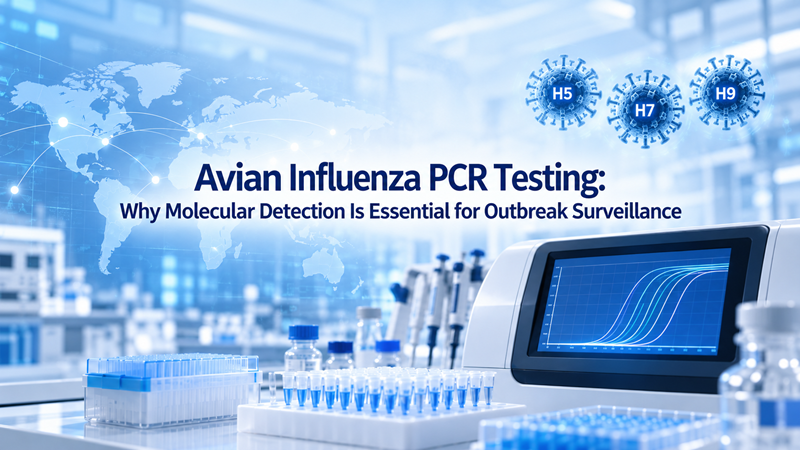
Separate the Subtype from the Pathogenicity Classification
The H component of influenza A subtype naming refers to haemagglutinin, while the N component refers to neuraminidase. Both are viral surface proteins used in subtype classification. H5 and H7 identify the haemagglutinin component without supplying a complete H-and-N designation. A report limited to those H targets therefore carries a specific naming scope, leaving the neuraminidase designation to evidence from an appropriate additional characterisation procedure.
High and low pathogenicity describe classifications that cannot be read directly from the H5 or H7 name. Some viruses within these subtypes are highly pathogenic, while most H5 and H7 viruses circulating in birds have low pathogenicity. The distinction matters because a subtype finding and an assessment of pathogenicity answer different surveillance questions.
A laboratory using an avian influenza test kit consequently defines the requested endpoint before interpreting the result. Identification of an included subtype provides evidence about a selected viral target. Claims about disease severity require additional evidence appropriate to that question, even when the subtype has already attracted attention within the surveillance programme.
Within avian influenza PCR work, differentiation can separate included subtype findings that a general influenza label would leave combined. The resulting categories give investigators a more specific starting point for reviewing laboratory observations. Their usefulness depends on retaining the measured target, rather than treating every H5 or H7 finding as an identical biological event.
Follow RNA into a Subtype-Specific Signal
Viral RNA carries the sequence information that an RNA-based molecular procedure investigates. Reverse transcription produces a DNA template, after which amplification and detection chemistry generate an observable response for selected sequences. Specificity comes from the assay’s defined target design and interpretation, not simply from the presence of a fluorescent signal during cycling.
Multiplexing brings several target assessments into a shared reaction process. Distinguishable responses preserve the individual target identities within that process, so the final interpretation can retain separate subtype findings. A laboratory still applies the method’s acceptance criteria to the observations; a combined reaction does not imply an unrestricted search across every influenza subtype.
Amplification relies on complementary sequence recognition within the selected target regions. The reaction conditions and detection design work together to distinguish an intended response from background observations.
Consequently, a fluorescence trace needs the assay’s interpretation criteria before it becomes a reportable target finding. The instrument displays reaction behaviour; the supported analytical procedure gives that behaviour its meaning for the particular subtype question being investigated.
A human respiratory application of avian influenza PCR is the BioPerfectus Avian Influenza Virus (H5/H7/H9) Real-Time PCR Kit. This multiplex assay qualitatively detects and differentiates H5, H7 and H9 viral RNA in human nasopharyngeal and oropharyngeal swabs. It supplies a specific human specimen route for subtype investigation within diagnostic and reference laboratory work.
Examine Controls and Low-Level Detection Together
Control assessment accompanies the target observations before a run yields an interpretable finding. An internal control is included in this BioPerfectus assay, providing a procedural check within the test’s interpretation framework. The control and the subtype responses have different analytical roles, so an unresolved control observation requires attention under the method’s instructions.
The stated limit of detection is five copies per reaction. That unit refers to target copies in the analytical reaction, not a count per collected swab or per patient. Translating it into another concentration would require the quantities and recovery relationships connecting collection, preparation and reaction input; the original figure alone does not supply them. Equal liquid volumes do not imply equal target quantities.
Near the low-copy end of testing, the material entering one reaction is an aliquot of a larger preparation. A small aliquot cannot represent every molecule in that preparation by direct enumeration. Detection-limit evidence therefore belongs to the assessed procedure and its conditions, with interpretation following the supported method instead of a universal promise about every specimen.
Carry Subtype Evidence into the Surveillance Record
A surveillance dataset can preserve separate H5, H7 and H9 fields alongside a specimen identifier and the method used. Recording the included targets also distinguishes an unmeasured subtype from one that was tested without detection. Those are different forms of missing and observed information, with different implications when laboratory records are grouped for review.
Method identity is particularly relevant when an avian influenza test kit enters a continuing programme. For the BioPerfectus human respiratory assay, the record can retain its defined target set and specimen category. A change to either the analytical scope or the submitted material needs to remain identifiable when earlier and later observations are compared.
The contribution of avian influenza PCR is a traceable subtype observation produced through an accepted procedure. Reviewing patterns can then begin with comparable records, while pathogenicity assessment retains its separate evidential requirements. Surveillance gains a firmer starting point when the investigation follows the measured finding, with the next question stated explicitly.